
Why Forno Sethi Uses Neapolitan Dome Design in Commercial Pizza Ovens
Since 2017, I have been involved in pizza oven manufacturing, consultations and installations across India. During this time, our team has reviewed more than 6,500 pizza oven enquiries and helped complete more than 270 installations for restaurants, cafés, cloud kitchens, resorts and catering businesses.
One thing I have consistently noticed is that buyers spend hours comparing oven size, appearance and pricing, but very few ask about dome geometry.
Yet, in our experience, dome design has a bigger impact on baking performance than many of the visible features buyers focus on.
That is one of the main reasons why Forno Sethi continues to use Neapolitan-inspired dome principles in its commercial wood fired pizza ovens.
Most Buyers Focus on Size and Price, Not Oven Geometry
During consultations, restaurant owners usually ask questions like:
- Which oven size should I buy?
- Should I choose wood or gas?
- How many pizzas can it produce per hour?
- What will be the price?
These are important questions, but very few buyers ask:
- How high should the dome be?
- What should be the oven mouth height?
- Where should the chimney be located?
- How does airflow affect baking?
- How much insulation should be used?
Over the years, we have realised that many performance issues are caused by these hidden engineering decisions rather than the features visible from the outside.
Why We Continue to Follow Neapolitan Dome Principles
The purpose of following Neapolitan principles is not to imitate Italy. The purpose is to achieve consistent baking performance.
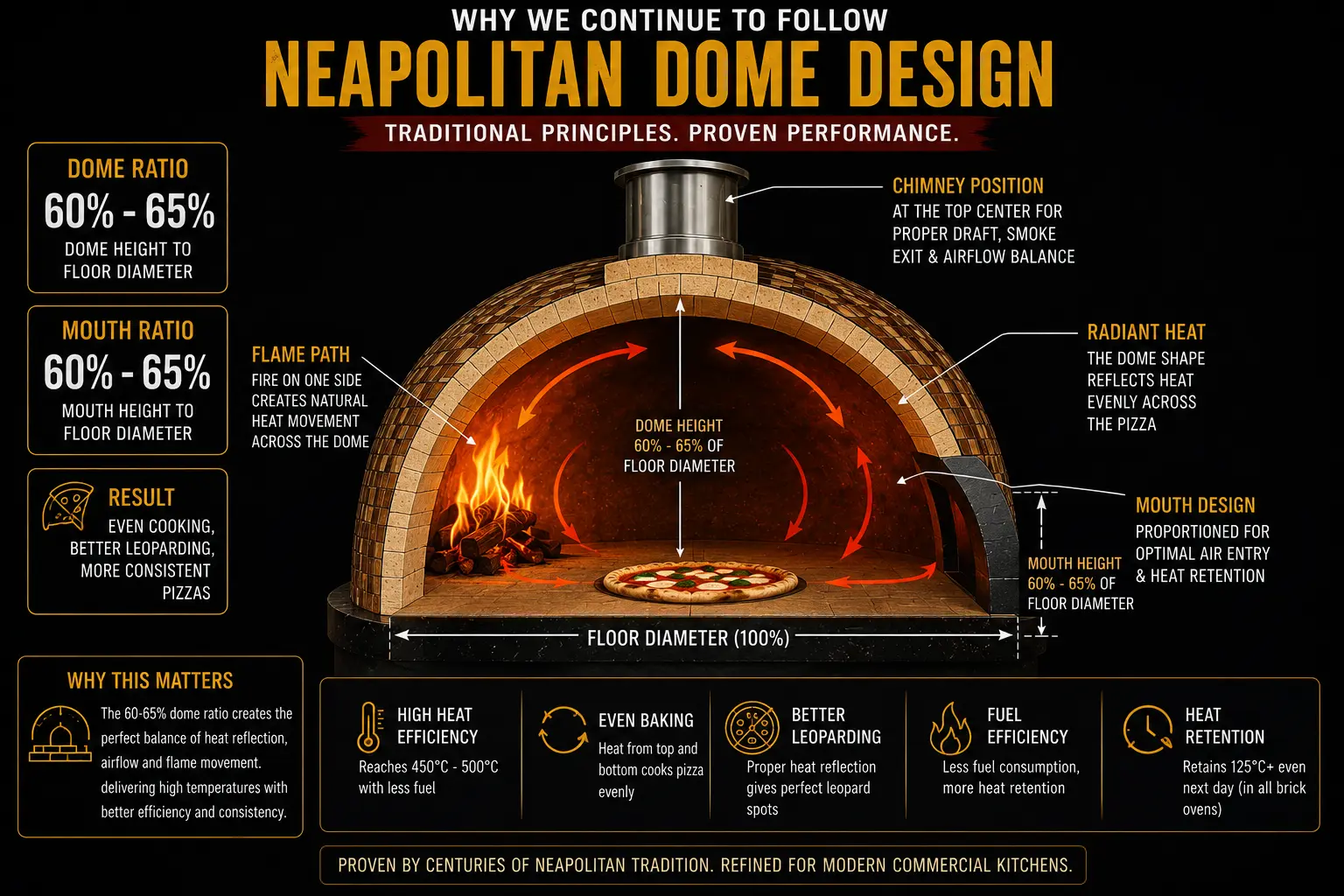
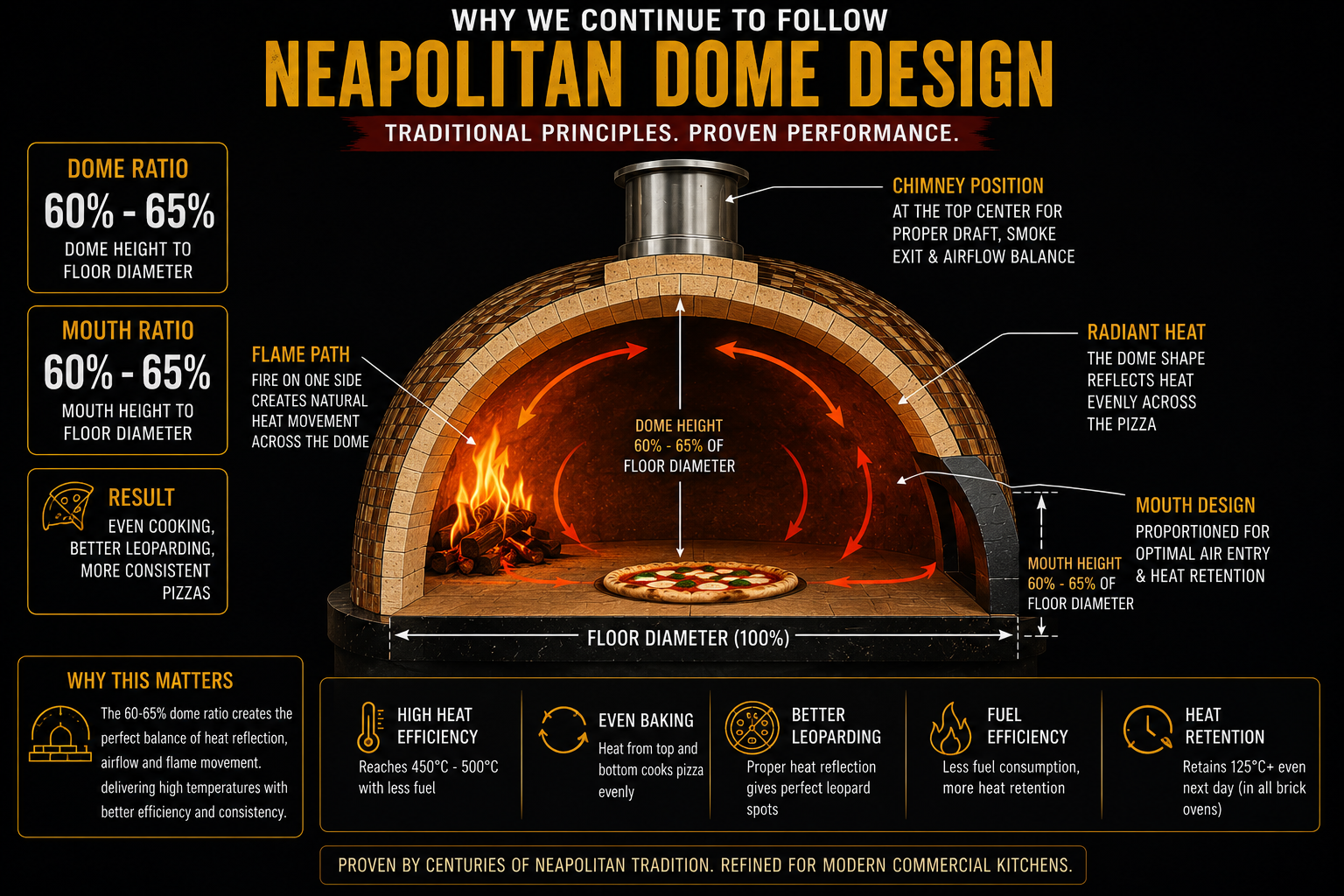
A properly designed low dome reflects heat efficiently and allows pizzas to cook evenly from both the top and bottom. It creates balanced heat circulation inside the chamber and helps maintain temperature during continuous commercial use.
As a general design philosophy, we prefer dome proportions where the internal dome height remains around 60% to 65% of the floor diameter. Similar relationships are maintained for the oven mouth dimensions.
These proportions help create proper flame movement, efficient airflow and balanced radiant heat.
In our experience, when these relationships are wrong, chefs spend more time managing temperature fluctuations instead of focusing on pizza production.
Not Every Attractive Oven Delivers Better Performance
Over the years, we have seen many visually attractive oven designs enter the market.
Innovation is important, but appearance should never come at the cost of thermal performance.
During our evaluation of various ovens available in the market, we occasionally come across designs where unique shapes have been prioritised over proven dome geometry.
We have seen ovens with:
- Excessively tall domes
- Incorrect oven mouth proportions
- Poor chimney positioning
- Weak airflow characteristics
- Uneven heat circulation
These ovens may look different, but baking consistency often suffers.
At Forno Sethi, our approach has always been performance first and aesthetics second. Mosaic finishes and designer exteriors can always be added later, but heat circulation cannot be corrected after the oven is built.
Before choosing an oven, restaurant owners should understand capacity, fuel options and production requirements. Our detailed Commercial Pizza Oven Buying Guide explains these factors in depth.
One of the Worst Designs We Commonly See
Perhaps one of the most common shortcuts we have observed is the use of fabricated metal domes that resemble an inverted cooking vessel.
Initially, these ovens may appear economical, but they often struggle to maintain stable temperatures.
Because metal and masonry materials expand differently during heating, improper connections around the oven mouth can create stress and increase heat loss over time.
Many such ovens also suffer from uneven cooking because the flame path and heat reflection are not properly controlled.
In commercial kitchens where consistency matters, these problems become increasingly visible during peak service.
Dome Design Alone Is Not Enough
A good dome alone does not create a good pizza oven.
The complete thermal system must work together.
1. Floor Construction Matters
We have seen some ovens where the floor bricks are installed using conventional cement mixtures or sand-based materials underneath.
In our experience, proper insulating layers below the cooking floor help minimise downward heat loss and improve overall thermal efficiency.
2. Refractory Brick Quality Matters
Not all refractory bricks behave the same.
For commercial temperatures around 450°C to 500°C, we prefer refractory materials that provide a balance between heat retention and thermal stability.
Material selection plays a major role in cooking consistency and long-term durability.
3. Proper Insulation Is Equally Important
Insulation is one of the most overlooked parts of pizza oven construction.
In our experience, adequate ceramic blanket insulation around the dome significantly improves heat retention and fuel efficiency.
Many of our brick ovens are capable of retaining usable residual heat even the following day when the oven is properly closed after service.
Why We Build Ovens for Indian Conditions
Italy and India are very different.
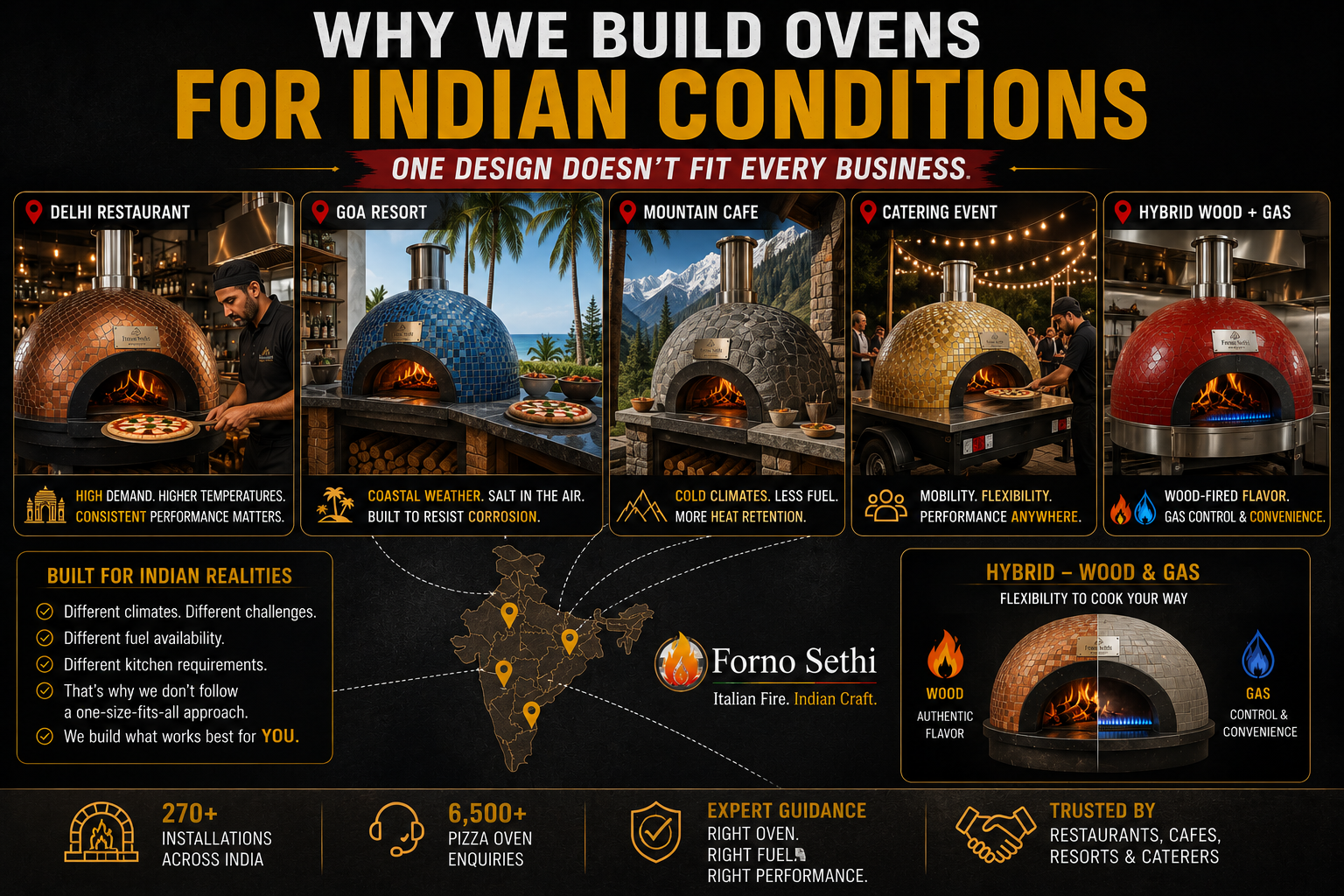
India has mountains, coastal regions, dry climates and cities with changing fuel regulations.
Some restaurants prefer wood. Others require gas. In several cities, wood and coal usage may be restricted because of environmental regulations.
This is why we focus heavily on hybrid wood and gas systems.
Rather than forcing customers into wood-only or gas-only solutions, we design ovens that provide flexibility according to local requirements.
Similarly, not every customer needs a brick oven.
In many cases, portability matters more than thermal mass, especially for catering businesses and outdoor events.
Our recommendations are based on usage requirements rather than simply selling the most expensive oven.
Not Sure Which Pizza Oven Is Right For Your Business?
After reviewing 6,500+ pizza oven enquiries and completing 270+ installations across India, our team can help you choose the right oven size, fuel type and configuration based on your actual production requirements.
Bigger Is Not Always Better
One of the biggest misconceptions we encounter is that a larger oven automatically means better performance.
In reality, the right oven depends on how many pizzas need to be produced during peak hours.
An oversized oven can consume more fuel and occupy unnecessary space.
Choosing the correct capacity is more important than choosing the biggest oven available.
Similarly, the most expensive oven is not always the best oven.
Performance depends on engineering, insulation, airflow and thermal efficiency—not just price.
Why We Still Use Neapolitan Dome Design
After reviewing more than 6,500 enquiries and completing over 270 installations since 2017, one lesson has remained constant.
Traditional Neapolitan dome geometry works.
Not because it is fashionable.
Not because it is Italian.
But because centuries of practical baking experience and modern thermal engineering continue to prove that these proportions deliver excellent heat circulation, fuel efficiency and baking consistency.
That is why Forno Sethi continues to build commercial pizza ovens around proven Neapolitan principles while adapting them for Indian fuel options, weather conditions and restaurant requirements.
Even the best dome geometry will not perform properly without correct airflow and chimney planning. Our Wood Fired Pizza Oven Setup & Installation Guide explains these requirements in detail.
About the Author
Anshul Sethi has been involved in pizza oven manufacturing, consultation and installation since 2017. He has reviewed more than 6,500 pizza oven enquiries and helped complete over 270 installations across India. His work focuses on adapting traditional pizza oven engineering for Indian restaurants, fuel availability and commercial cooking requirements.
Explore Forno Sethi Commercial Wood Fired Pizza Ovens
Built around proven Neapolitan dome principles and adapted for Indian conditions, Forno Sethi ovens are designed for restaurants, cafés, cloud kitchens, resorts and catering businesses that demand consistent high-temperature performance.
- ✔ Brick Pizza Ovens
- ✔ Hybrid Wood + Gas Ovens
- ✔ Portable Catering Pizza Ovens
- ✔ On-Site Installation Support
- ✔ Pan India Delivery

Anshul Sethi is the founder and design engineer behind Forno Sethi, an in-house manufacturer of commercial wood fired, gas, and hybrid pizza ovens based in Delhi. With over 10 years of experience in heavy metal fabrication and thermal engineering, he has consulted on 6,500+ commercial kitchen setups and 250+ installations across India, specializing in brick oven construction, burner engineering, and kitchen ventilation planning.